

Over the past decade, I have faced more adversity than I ever could have imagined. I have experienced circumstances that have tested my strength, challenged my beliefs, and forced me to look at life, human nature, and my own purpose in ways that most people may never fully understand.
I have felt surrounded by what I perceive as hostility from different individuals, groups, and associations. Even today, I have concerns about people who, in my view, want to see me fail, break down, or give up. Some people have asked me, “Aren’t you afraid? Aren’t you afraid of being hurt, kidnapped, tortured, or even killed?”
I have thought about that question long and hard. And the answer I have arrived at is more complicated than simply saying I am not afraid.
Fear is human. I would never pretend otherwise. But I have come to believe that there are things in life more powerful than fear. One of them is having a purpose that means more to you than your own comfort, your reputation, or even your sense of security.
For me, that purpose is the Free Will Project.
I believe there is a God. I believe He gave us something extraordinary: the ability to think for ourselves, to make our own decisions, and to choose the paths we take in life. That ability is what we call free will. We are not simply passengers waiting to see where life takes us. We have choices. And those choices carry responsibility.
To me, free will is not just a philosophical idea or a religious teaching. It is a reminder that every human being has a responsibility to think, to question, to seek the truth, and to decide for themselves what they believe. Faith that is forced is not the same as faith freely chosen. And a truth worth sharing should never require someone to surrender their ability to think independently.
That is why I feel such a responsibility to share my beliefs with the world. Not to force anyone to agree with me, not to tell people what they must believe, and certainly not to claim that I have all the answers. My purpose is to encourage people to think for themselves, to recognize the power of their own choices, and to understand that their free will is something precious.
So, when people ask whether I am afraid to speak my truth or continue this mission, I come back to one simple thought.
the free will project
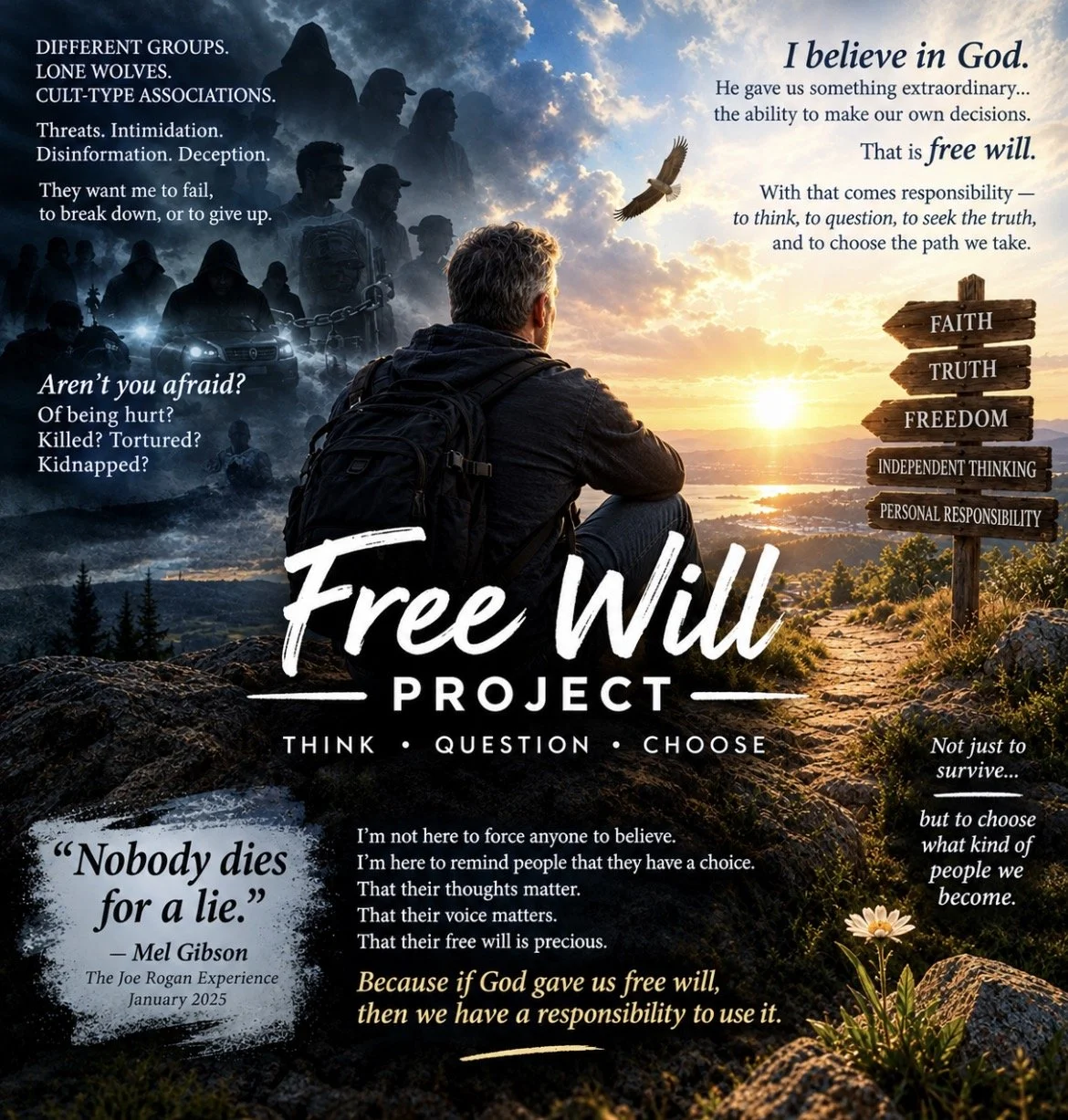
Nobody dies for a lie
Those words gained renewed attention when Mel Gibson used the argument during his
appearance on The Joe Rogan Experience in January 2025. The idea behind the phrase is simple, even if its implications are profound: there is a difference between suffering for something you believe to be true and knowingly sacrificing everything for something you know you invented.
I understand that people can disagree about what those words mean, and I do not expect a single phrase to settle every question about faith, history, or human nature. But the principle speaks to me personally. There comes a point when your convictions become so deeply rooted that abandoning them simply to avoid criticism, intimidation, or adversity would mean abandoning a part of who you are.
I cannot ask other people to think freely if I am unwilling to stand behind what I believe. I cannot speak about personal responsibility while allowing fear alone to dictate every decision I make. And I cannot talk about faith and free will without accepting that I, too, must exercise the freedom to choose my own path.
The Free Will Project is about that choice.
It is about recognizing that we may not control everything that happens to us, but we can still take responsibility for how we respond. It is about understanding that adversity does not have to define us, that disagreement does not have to become hatred, and that the freedom to believe must be accompanied by the freedom to question.
I do not claim to know everything that lies ahead of me. I cannot promise that the road will be easy, and I will not pretend that a belief in God makes a person immune to hardship. Faith does not mean the absence of fear. Sometimes, it means choosing to move forward while acknowledging that fear exists.
But I refuse to let fear become the author of my life.
If I have learned anything over these past ten years, it is that a person’s life should be measured by more than the adversity they endure. It should also be measured by what they choose to stand for, what they contribute to others, and whether they have the courage to live according to their deepest convictions.
I am choosing to stand for faith, personal responsibility, independent thought, and the freedom every human being should have to make their own decisions.
That is my truth. That is my purpose. And that is why I continue with the Free Will Project.
Because if God gave us free will, then we have a responsibility to use it—not merely to survive, but to choose what kind of people we become.
And if my life can encourage even one person to think more freely, question more honestly, find faith on their own terms, or discover the courage to make a better choice, then the adversity I have faced will not be the only story my life tells.
My story will also be about what I chose to do with it.
That is the Free Will Project. And that is why I will continue.